
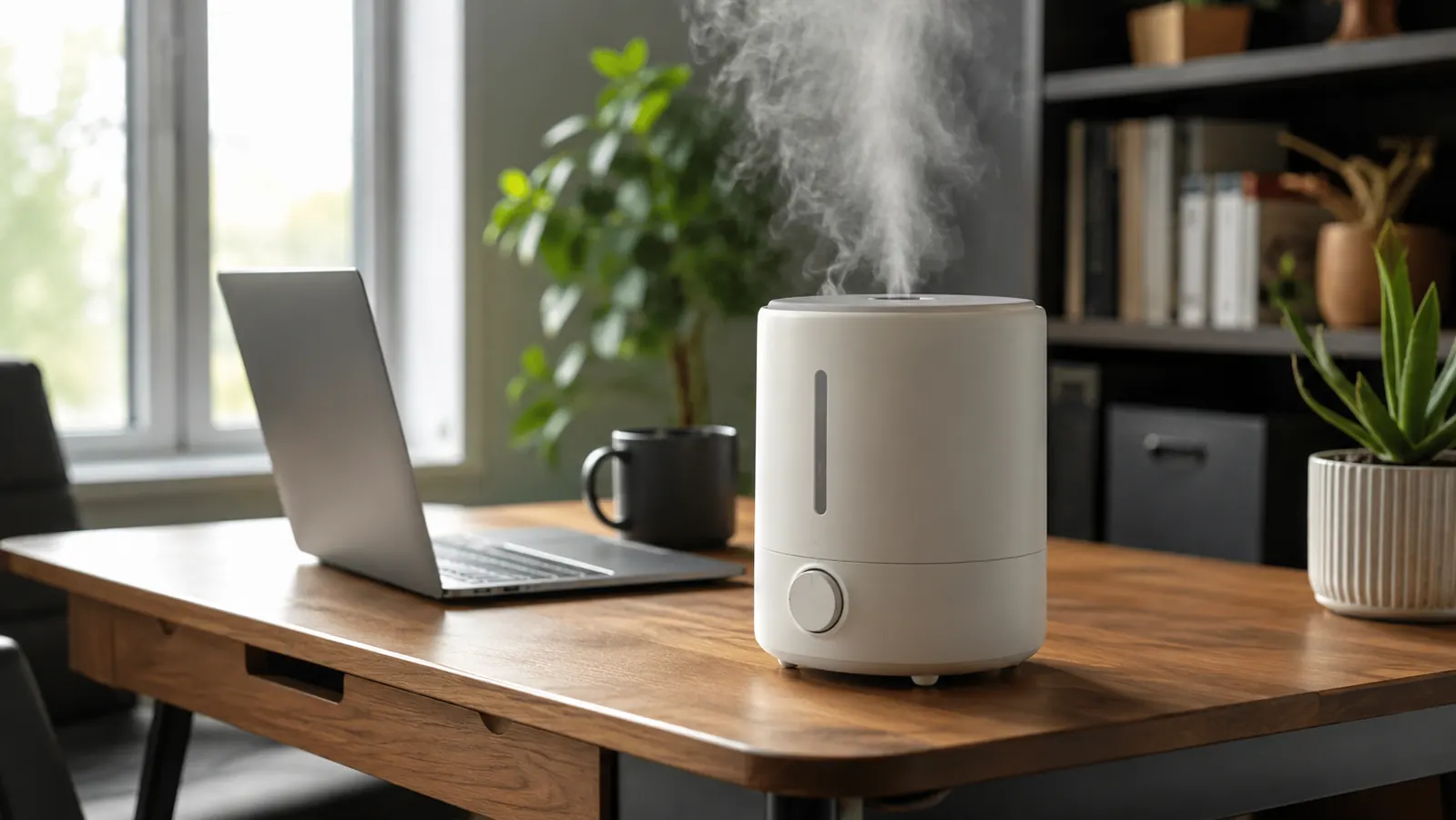
I have set up more home offices around Columbus than I can count, and once the furnace kicks on in November, the same complaints start rolling in. Cracked knuckles. Eyes that feel gritty by ten in the morning. A static shock off the doorknob strong enough to make you swear out loud. None of that is a coincidence, forced-air heat strips moisture out of a small enclosed office fast, and most people just live with it. There is a cheap, simple fix, and it sits right on the corner of a desk, which is exactly where I keep mine, a GENIANI Portable Cool Mist Humidifier that has quietly become one of the first things I tell every Columbus client to buy.
This is not a whole-house appliance and it is not trying to be. The GENIANI humidifier is built for a single room, an ultrasonic unit with a 250ML tank, an auto shut-off so it does not run dry mid-call, and a footprint smaller than a coffee mug. I have run one at my own desk for the better part of two winters now, and below are ten specific reasons a small unit like this earns its spot next to your keyboard instead of gathering dust in a closet.
Your Furnace Is Drying Out Your Office. A Space Heater Just Makes It Worse.
Forced-air heat and a desk space heater both pull moisture out of the air around you. A desk humidifier puts a little of that moisture back exactly where you sit. See today's price on the GENIANI Portable Cool Mist Humidifier.
Amazon Check Today's Price on Amazon →A Desk Humidifier Stops Dry Winter Air From Cracking Your Skin and Lips
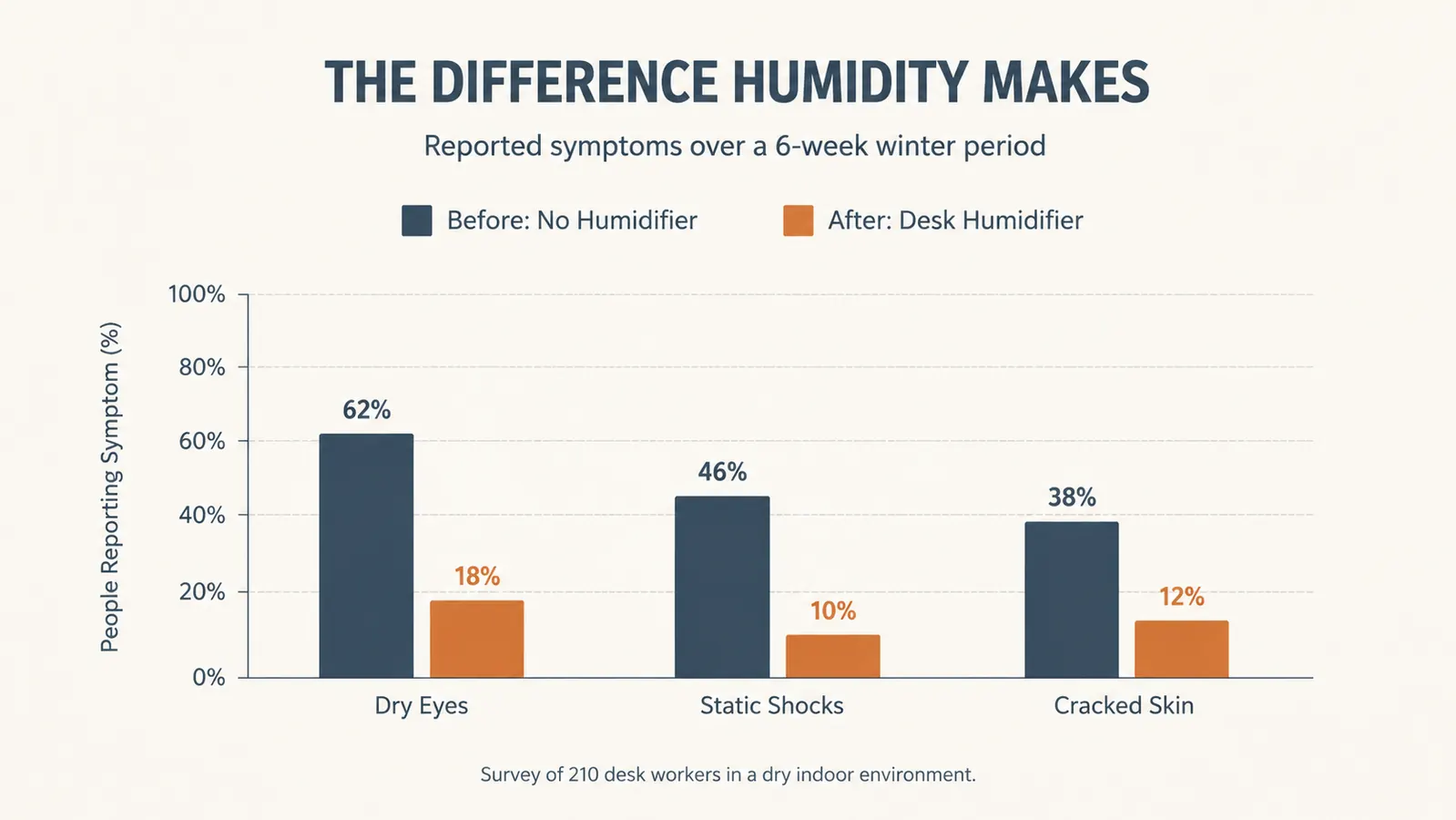
By January, my knuckles used to split at the same crease every winter, right where they bend to hold a mouse for eight hours a day. That is not a lotion problem, it is an air problem. Indoor humidity in a heated Columbus home routinely drops below 20 percent in the dead of winter, and skin cannot hold onto moisture in air that dry no matter what you rub into it. Running the humidifier at my desk kept the air closer to a comfortable 40 to 50 percent, and the cracked knuckles stopped showing up.

A Desk Humidifier Keeps Your Eyes From Feeling Like Sandpaper by Noon
Dry office air pulls moisture off the surface of your eyes the same way it pulls it out of your skin, and staring at a monitor all day means you already blink less than you should. Add those two things together and by lunchtime your eyes feel gritty, tired, and irritated in a way that has nothing to do with how much sleep you got. I go into more detail, including exactly how long it took to notice a difference, in <a href='geniani-humidifier-fixed-my-dry-eyes'>how a desk humidifier fixed my dry eyes</a>.
A Desk Humidifier Cuts Down on Static Shocks From Your Keyboard and Chair
Static builds up fastest in air with almost no humidity, which is exactly what a heated office is by February. I used to get zapped rolling my chair back from the desk or reaching for a paperclip almost daily, sharp enough to make me flinch. Once I started running the humidifier consistently, the shocks nearly disappeared. Moist air conducts away the static charge before it builds up enough to bite you, which is also gentler on any electronics sitting near your keyboard.
A Desk Humidifier Eases the Scratchy Throat That Isn't Actually a Cold
Every winter I get a client convinced they are catching something because their throat is scratchy on video calls, and half the time it is just the furnace. Dry air irritates the mucous membranes in your throat and nose the same way it dries out your skin, and sitting in a closed office for eight hours gives it plenty of time to work on you. A little added humidity right at your desk takes the edge off within a day or two, no cold medicine required.
A Desk Humidifier Helps Stop Random Winter Nosebleeds
Nothing derails a workday like a nosebleed in the middle of a client call. The inside of your nose is lined with delicate blood vessels close to the surface, and when winter air dries that lining out, it cracks more easily than most people realize. This one is not universal, some people never deal with it at all, but if you are prone to it, a desk humidifier running through the coldest months is one of the cheapest fixes I have recommended to a client.
A Desk Humidifier Takes the Edge Off Sinus Headaches
Dry sinuses do not drain the way they are supposed to, and that backup pressure is a common, underrated cause of the dull headache that shows up behind your eyes by mid-afternoon in winter. It is easy to blame screen time or bad posture instead. Keeping the air around your desk humid enough helps your sinuses actually function instead of fighting a moisture deficit all day. I walk through the exact setup I use, including how close to keep it to your face, in <a href='how-to-use-desk-humidifier-for-dry-winter-air'>how to use a desk humidifier for dry winter air</a>.
A Desk Humidifier Protects Wood Desks and Trim From Cracking
It is not just your body that suffers in bone-dry air, real wood furniture does too. Solid wood desks and trim can develop hairline cracks over a hard winter if the room stays too dry for months at a stretch. A small humidifier will not undo damage that is already there, but keeping the air around your desk in a reasonable range protects wood finishes from the slow cracking that shows up after a few dry seasons in a row.

A Desk Humidifier Keeps Desk Plants From Wilting No Matter How Much You Water Them
I had a pothos on my desk that I was convinced I was killing through neglect, browning at the tips no matter how often I watered it. Turns out the soil was fine, the air was the problem. Most houseplants prefer humidity well above what a heated office holds in winter, and no amount of watering the roots fixes leaves drying out from the air around them. Running the humidifier nearby solved it faster than any plant food I tried first.
A Desk Humidifier Runs Quiet Enough to Sit Through Every Call
A lot of humidifiers are built for bedrooms and living rooms, loud enough that you would never put one within earshot of a work call. An ultrasonic unit like this has no fan and no boiling water, just a small vibrating disc pushing out a fine mist, so the loudest thing you hear is a faint hum you stop noticing within a day. If you are weighing a small desk unit against a bigger room humidifier, I break down the tradeoffs in <a href='geniani-humidifier-vs-large-room-humidifier'>desk humidifier vs a large room humidifier</a>.
A Desk Humidifier Is Cheap Enough That Skipping It Doesn't Make Sense
This is the part that gets me every time I recommend one. A small desk humidifier costs less than a single office supply run, refills with tap water, and needs nothing more than a rinse every week or two to keep running clean. Compared to what dry winter air costs you in cracked skin, irritated eyes, and static shocks off your own keyboard, it is one of the lowest-effort fixes I put in front of a client all year.
What I'd Skip
I will be straight with you, a 250ML tank on a small unit like the GENIANI humidifier means refilling it daily if you run it a full eight-hour shift, so do not expect it to be a fill-it-once-a-week appliance. I also would not run it directly next to a laptop's air vents or on top of paper documents, keep it a foot or so away and let the mist disperse into the room. And if your whole house runs dry, not just your office, a small desk unit is a good start but it will not solve a house-wide humidity problem on its own. It is built to fix the air around one desk, and it does that job well.
The static shocks stopped before I even noticed my knuckles had healed.
Ten Small Fixes for the One Thing Your Furnace Won't Stop Doing
None of these reasons alone undo a whole Columbus winter, but together they add up to an office that does not fight you all season. That is what a small desk humidifier delivers, right where you sit.
Amazon Check Today's Price on Amazon →