

Desk humidifier is the two word fix for a problem that gets worse every winter in a home office: the air dries out, your sinuses dry out, and by 2pm your throat feels like sandpaper. I've been setting up remote work spaces here in Columbus, Ohio for years now, and my own converted bedroom office runs forced air heat that drops relative humidity into the low 20s by January. That is desert territory, drier than Phoenix most winter afternoons. The first humidifier I tried was a big console unit meant for a whole bedroom. It fogged up half the room and did almost nothing for the air I was actually breathing eight hours a day, six feet from a heating vent.
What actually worked was small and cheap: a GENIANI Portable Cool Mist Humidifier sitting directly on the desk, close enough to raise the humidity in the two or three feet of air around my face and keyboard instead of trying to heat the whole room. I've been running mine since the second week of November, and this guide walks through exactly how I set it up, run it day to day, and clean it, because the cleaning part is where most people quietly ruin a good humidifier and never figure out why it started smelling musty by January.
Dry office air isn't just uncomfortable, it's a productivity problem. Static shocks jumping off your keyboard, chapped hands on cold mornings, a scratchy voice by your 3pm client call, contact lenses that feel like sandpaper before lunch. Our IT lead pointed out once that static discharge gets more likely near sensitive electronics once relative humidity drops below 30 percent, which is one more reason a small humidifier at your actual desk is worth the five minutes a week it takes to maintain.
Tired of Cracked Hands and a Scratchy Throat by Lunch?
A desk humidifier fixes the air you're actually breathing, not the whole room. See today's price on the GENIANI Portable Cool Mist Humidifier before winter dries you out again.
Amazon Check Today's Price on Amazon →Step 1: Pick the Right Spot on Your Desk
Placement matters more than people expect. You want the mist landing in open air, not aimed directly at your keyboard, laptop vents, or a stack of papers, and not tucked in a corner where it just condenses on the nearest wall. I keep mine about two and a half feet from my face, angled slightly away from my monitor, sitting on a small rubber coaster to catch any condensation before it touches the desk finish. On my old desk I skipped the coaster for a month and ended up with a faint white ring in the wood finish that never fully sanded out.
Give it a few inches of clearance on every side too. I made the mistake early on of tucking mine right against my desktop tower, and the exhaust fan on the tower started pulling in a little extra moisture, which is not what you want anywhere near a computer. A small humidifier like this throws mist a foot or two into the air depending on the setting, so treat that radius as electronics free space, same rule you'd apply to a coffee mug, just with a bigger blast zone.
Keep it out of direct sun and away from a heating vent blowing straight at it too. Both dry the mist out before it ever reaches you, which defeats the purpose. On a laminate or veneer desk, I'd still use a coaster even though the risk of a water ring is lower than on solid wood, mostly because it keeps the base from sliding around when you nudge the desk while typing. Small habit, but it's saved me from knocking mine over more than once.

Step 2: Fill the Tank the Right Way
The 250ML tank fills through a cap on top, no need to flip the whole unit over like some of the older humidifiers I've used. Fill to the marked line, not past it. Overfilling is the number one reason people come back frustrated that their unit is leaking, when really the tank is just too full and pushing water back out through the mist vents once you set it down. I learned this one the hard way during my first week, thought the unit was defective, and it turned out I'd filled it almost to the rim out of habit from a bigger console humidifier.
Use distilled or demineralized water if you can. Tap water works, but the minerals in Columbus city water leave a fine white dust on your desk over time, called mineral scale, and that same buildup coats the ultrasonic disc inside the tank and shortens how long it runs well. I switched to a gallon of distilled water from the grocery store about six weeks in and the white dust on my monitor stand basically disappeared. It's a small cost, a few dollars a month, for noticeably less cleaning later.

Step 3: Dial In the Mist Level and Run Time
Most small ultrasonic humidifiers, the GENIANI included, give you a low and high mist setting. I run mine on low almost all day, which stretches a single 250ML fill to roughly 8 to 10 hours, plenty for a full workday. High mist looks more dramatic and clears a stuffy room faster if you've just walked in from outside, but it also empties the tank in under 4 hours and puts more moisture into the air than a small office space usually needs. Start on low and only bump it up if the air still feels dry after a day or two.
The auto shut off is worth actually relying on rather than watching the clock yourself. Once the tank runs dry, the unit stops misting instead of running the ultrasonic disc dry, which would wear it out fast. I still don't run mine unattended overnight, mostly because I'd rather not have any small appliance running in an empty room for eight hours, but during the workday I let the auto shut off do its job and just refill when I notice the mist has stopped.
Noise is worth mentioning too, because it's the first thing coworkers ask about on video calls. On low, mine is close to silent, just a faint hum you stop noticing within a few minutes. On high, there's a slightly louder whir from the fan pushing mist further out, still nowhere near as loud as a desk fan, but noticeable enough that I switch back to low before joining a call so it doesn't pick up on the microphone.
Step 4: Clean the Tank Every Few Days
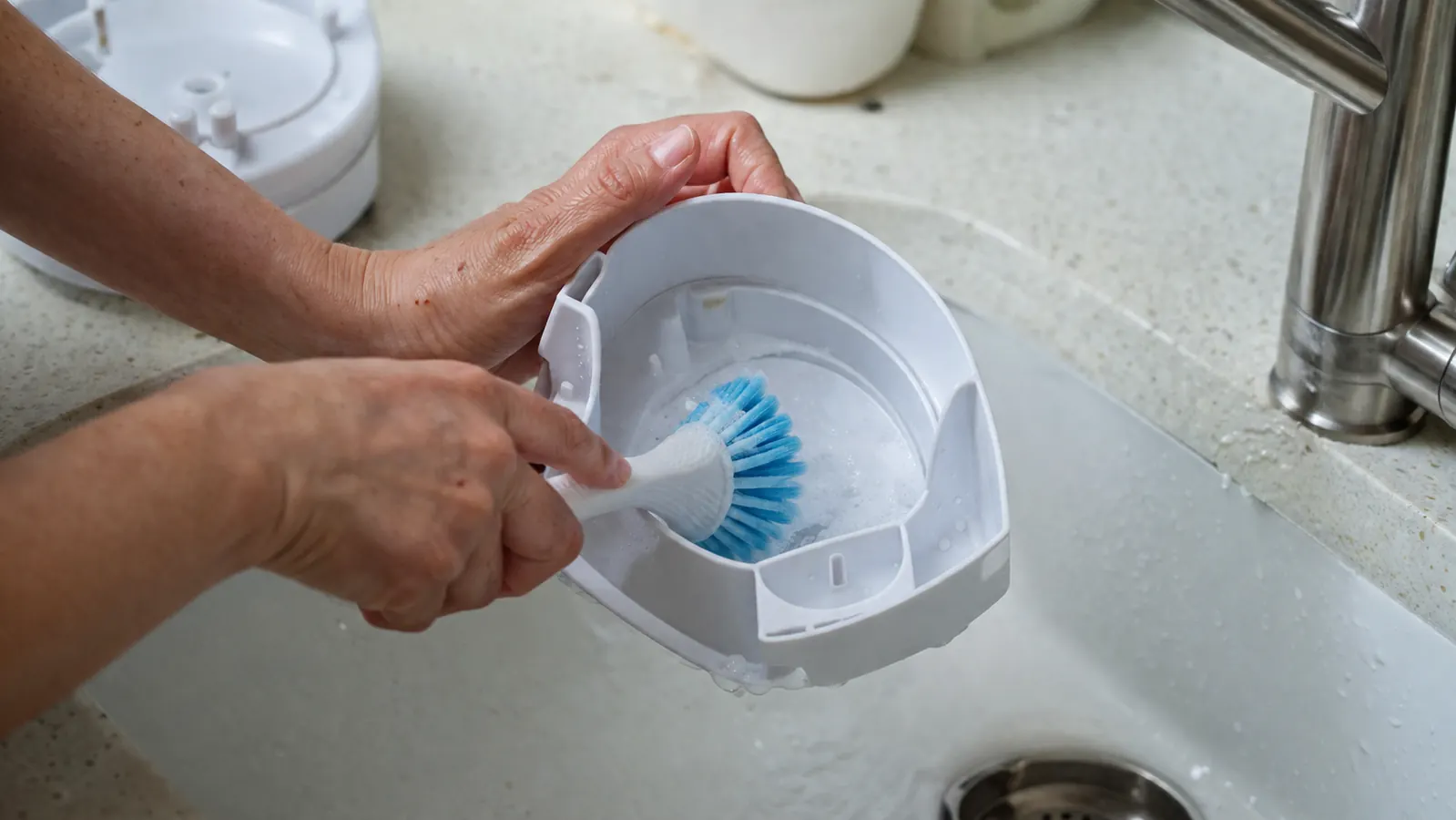
This is the step people skip, and it's the one that actually matters most. Stagnant water sitting in a warm tank for four or five days straight is exactly the environment mold and bacterial film grow in, and once that happens, your humidifier is spraying that film into the air you breathe all day. I empty and rinse the tank every two to three days minimum, more often if I've been sick, using a soft bottle brush to get into the corners where a quick rinse alone won't reach. If you notice a musty smell when you fill it, that's your sign you're already behind on cleaning.
Once a week, I do a proper deep clean on the tank: a mix of white vinegar and water, roughly equal parts, swished around and left to sit for 15 to 20 minutes to break down mineral buildup and any early biofilm on the walls. Then a rinse, three or four times, until there's no vinegar smell left. Never use bleach on the ultrasonic disc itself, it can damage the metal contacts. A cotton swab dipped in vinegar works well for the tight seam around the disc where grime tends to collect.
Signs Your Humidifier Needs Attention
A few warning signs tell you you're behind on maintenance before it becomes a real problem. A fine white film on your desk or monitor stand near the unit means mineral scale is building up faster than you're cleaning it off. Weaker mist output than when it was new usually means the ultrasonic disc has scale on it and needs a vinegar soak. And any musty or sour smell when you open the tank, even faint, means bacteria or mold has already started, not might start, and it's time for a full clean before you refill it again.
I keep a recurring reminder on my calendar for the deep clean because relying on memory alone means it slips during busy weeks, which is exactly when dry office air is hardest on you anyway. Five minutes every Friday afternoon has kept mine running clean and quiet through two full winters now, no off smells, no weak mist, no white film creeping across my desk.
Step 5: Descale and Store It Between Seasons
If you're using tap water, plan on descaling the ultrasonic disc about once a month. Let it soak in the same vinegar and water mix for 20 to 30 minutes, then gently brush the disc with a soft toothbrush, never anything metal, to knock loose the chalky white buildup without scratching the surface. A scratched disc doesn't atomize water as evenly, and you'll notice weaker mist output within a few weeks of damaging it.
When spring rolls around and you're done needing extra humidity for the season, empty the tank completely, run it dry for a few minutes on a paper towel, and let every part air dry fully before you put it away. Store it with the tank cap off in a dry cabinet, not sealed in a bag while even slightly damp, or you'll open it in October to a moldy surprise. If the tank ever cracks or the base won't stop leaking even when filled correctly, that's the point to replace the unit rather than keep patching it.
What Else Helps
A desk humidifier only solves part of the dry air problem. I keep a cheap hygrometer next to my monitor so I can actually see the number instead of guessing, and I aim for 30 to 50 percent relative humidity, not higher. Push past 60 percent in a small room and you risk the same mold growth you were trying to avoid in the first place, just on your windowsill instead of in the tank. If you're deciding whether a single desk unit is even enough for your space, I broke down that exact question in GENIANI humidifier versus a large room humidifier, since the answer depends a lot on your room size and how dry your specific house runs.
Sealing up obvious drafts helps just as much as the humidifier itself. A weatherstrip along the bottom of an old office door, or a rolled towel against a drafty window, keeps the dry outside air from constantly cycling through the room and undoing what the humidifier just added. I noticed a bigger jump in comfort after fixing a gap under my office door than I did from any single change to the humidifier settings, which surprised me at the time but makes sense in hindsight.
For anyone still deciding whether this specific model is worth adding to a desk setup at all, I laid out the full pros and cons in my honest GENIANI humidifier review, and a coworker's story is in how a desk humidifier fixed her dry eyes after months of eye drops not helping.
A humidifier that never gets cleaned isn't helping your dry office air, it's just misting mold into it every afternoon.
Ready to Stop Fighting Dry Office Air Every Winter?
Five minutes of setup and a couple minutes of cleaning a week is all it takes. See today's price on the GENIANI Portable Cool Mist Humidifier and get ahead of the dry season.
Amazon Check Today's Price on Amazon →